dim Piano Chords
Dim names a three-note diminished triad, not dim7 or half-diminished 7. Its tritone and leading-tone motion explain why it so often points to another chord.
Diminished structure, shown with C
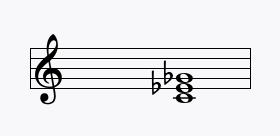
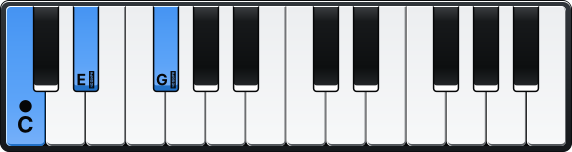
Cdim is C–E♭–G♭. Two stacked minor thirds place G♭ a diminished fifth above C, producing the compact 0–3–6 structure of a diminished triad.
What diminished quality means
The pull of vii° toward tonic is a common tonal use, not a command built into the three-note quality. Context determines whether and where it resolves.
Diminished triads in harmonic context
Cdim can point upward as a leading-tone chord or prepare the dominant in a minor key.
Hear the lowered fifth resolve
Cdim → D♭
- Common tones
- Moving voice
- C → D♭ · E♭ → F · G♭ → A♭
C moves up a semitone to D♭, E♭ moves up a whole tone to F and G♭ moves up a whole tone to A♭.
Dim chord symbols
Cdim and C° name the diminished triad. Cm♭5 may describe the same three notes but is less direct.
Triad, half-diminished and diminished 7
Cdim is C–E♭–G♭. Cm7♭5 adds B♭, while Cdim7 adds the differently spelled diminished seventh B𝄫.